
Custom price and stock alerts for online stores
Get tailored competitor price, stock, margin and sales alerts by email or SMS. Send the right updates to each person, with screenshots and smart filtering.
Let your competitors make a move. PriceZag will tell you about it. Instead of repeatedly checking product pages, get automatic alerts when a competitor drops a price, runs out of stock, crosses a pricing threshold, or makes another move worth your attention.
And these are much more than basic price drop notifications. PriceZag combines competitor price and stock monitoring with flexible alert rules, screenshots, recipient-specific settings and intelligent email delivery. Whether you run a small online store, manage a large product catalog or monitor retailers for a brand, you can choose exactly which changes deserve a message.
Know when something important changes
PriceZag checks the product-page URLs you monitor. When a price or stock observation changes, the platform evaluates your alert rules and queues any matching notifications. Related alerts can then be grouped into a clear email, rather than arriving as a flood of separate messages.
For example, you might want to know when a competitor cuts a price by more than 5%, when your product is no longer the cheapest, or when an out-of-stock rival gets inventory back. Another store might care more about protecting margins or spotting opportunities to raise prices. You can configure both approaches - and many others - without writing code.
You do not have to connect a particular ecommerce platform to use alerts. PriceZag monitors the product pages you specify, so the same alerts can help store owners, pricing teams, manufacturers and distributors.
The right alerts for the right people
Send alerts to as many email recipients as you need, each with their own rules and delivery preferences. Recipients do not have to be PriceZag users. There is no separate charge per email recipient or notification: alert delivery is included in your plan.
This is especially useful when different people are responsible for different products or decisions:
- Category managers can receive alerts only for the product categories they manage - cameras for one person, power tools for another.
- Pricing managers can follow aggressive competitor price cuts, changes in price ranking and margin thresholds across the catalog.
- Purchasing teams can focus on competitors going out of stock or returning to stock, helping them identify changing market availability.
- Brands and distributors can watch retailers advertising below their Minimum Advertised Price (MAP), then review the captured evidence.
- Business owners can choose broader, less frequent summaries while the team receives more specific operational alerts.
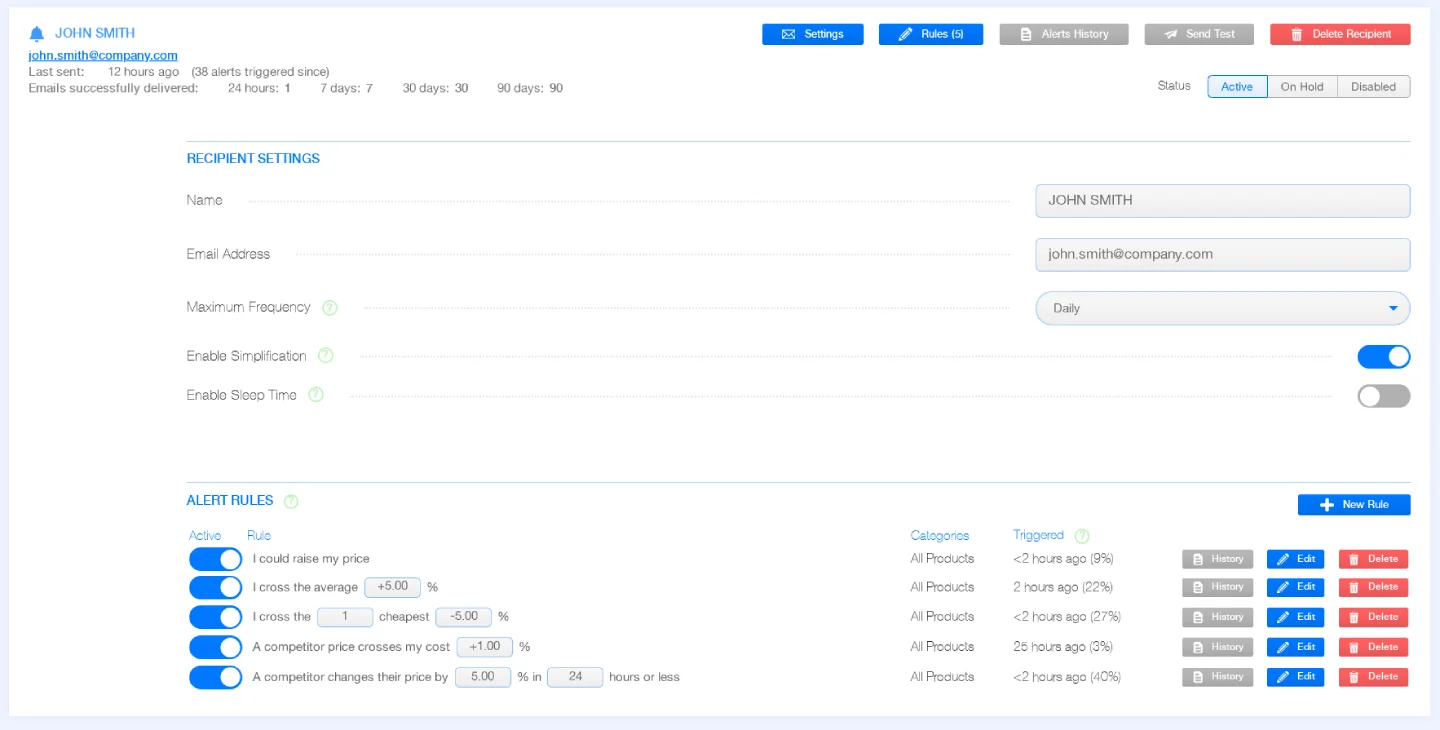
One recipient can have several rules, and each rule can apply to all products or only selected categories. You can even send different alerts to two people responsible for the same products. Everyone sees what is relevant to their job.
What can trigger a PriceZag alert?
The rules cover far more than a product's price changing. You can react to a competitor's behavior, your own competitive position, market-wide trends and even certain account issues. Here are the main possibilities:
| Alert type | What you can watch | Why it matters |
|---|---|---|
| Competitor price changes | A competitor's price rises or falls by a chosen percentage within a chosen number of hours. | Catch meaningful price cuts or increases without reacting to every tiny adjustment. |
| Price thresholds | A competitor crosses a fixed amount in a chosen currency, or crosses your product cost plus a percentage. | Spot a retailer undercutting an important price point, margin threshold or MAP reference. |
| Your price ranking | Your position among monitored prices improves or worsens by a chosen number of places. | Find out when another seller overtakes you, even if your own price stays the same. |
| Cheapest, most expensive and average prices | Your price crosses the market average or the average of the X cheapest or X most expensive competitors, with an adjustable percentage offset. | Follow your position in the market instead of focusing on just one rival. |
| Market-wide changes | The competitors' average price changes by a chosen percentage within a time window, or crosses a fixed amount. | Recognize wider pricing shifts across the sellers you monitor. |
| Stock and availability | A competitor's stock crosses a selected quantity, including going out of stock or becoming available again. | Identify supply gaps, restocks and sales opportunities. |
| Estimated competitor sales | A competitor appears to sell at least a selected number of units within a time window, where stock data allows estimation. | Notice potentially fast-selling products using PriceZag's sales estimates. |
| Your own pricing and margin | Your price changes by a chosen percentage, or your margin crosses a specified percentage. | Keep an eye on your own price movements and profitability. |
| Opportunities and account issues | PriceZag detects a possible opportunity to raise your price, cannot retrieve the price from your own monitored site, or encounters a membership payment failure. | Surface opportunities and practical problems that might otherwise be missed. |
For many rules you can choose whether to react to price increases, decreases or both. Some compare changes over a time window; others trigger only when a particular line is crossed. That distinction matters: knowing that a competitor is already cheap is different from being notified when they become cheaper.
Filter out the noise before it reaches you
A useful alert is one that tells you something you can act on. PriceZag lets you narrow eligible products and competitor websites rather than treating every price movement as equally important.
- Choose categories. Limit an alert rule to specific product groups, or use all products if you prefer.
- Target a particular retailer. Filter competitor URLs by text they contain - often a domain name - or exclude URLs you do not want considered.
- Ignore out-of-stock competitors. For supported rules, exclude unavailable offers from price comparisons so an unusable low price does not distract your team.
- Set meaningful thresholds. Choose your own percentages, monetary amounts, price offsets, stock levels, time windows and movement directions as the rule allows.
Useful details, directly in your inbox
PriceZag's HTML alert emails are designed to be read, not decoded. Alerts are grouped by product, with the product name and reference code, your own price and clear descriptions of what changed. Prices are color-coded, with visual indicators for increases and decreases, making it easy to scan a message containing several products.
The links are just as important as the numbers. You can open the product in PriceZag, follow a link to the retailer's listing, or click the camera icon beside a competitor alert to see a screenshot of the product page captured when that alert was triggered. That is especially helpful when the advertised price has changed again by the time you read the email.
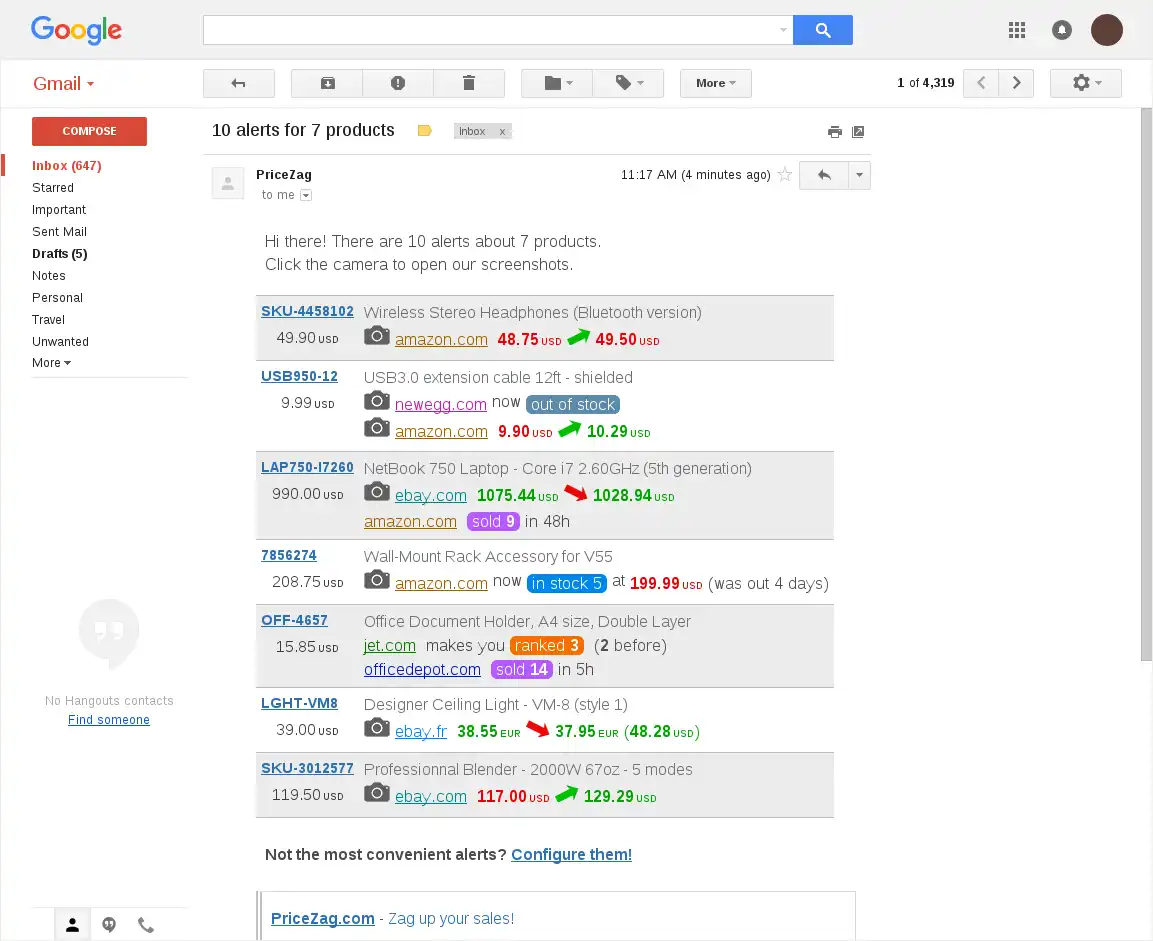
Emails also include a plain-text version and a link back to your alert preferences, so recipients can adjust notifications if their needs change.
Powerful alerts without an overflowing inbox
One of the most useful parts of PriceZag's alert system is what happens between detecting a change and sending the message. Each recipient has three independent controls to make notifications fit their workday.
Maximum Frequency: group changes into fewer messages
Choose how frequently alert messages may be sent, from every 30 minutes to daily, with several options in between. PriceZag can collect multiple triggered alerts and send them together. Someone who needs urgent price-drop notifications can choose a shorter interval, while another recipient can opt for a calmer digest. More grouping can mean a little more delay before delivery.
Simplification: skip changes that cancel themselves out
Enable Simplification is on by default, and for good reason. Suppose a competitor drops a price from $120 to $110 and then to $100 before an email goes out. Instead of sending two separate changes, PriceZag can report the meaningful result: $120 to $100.
Or imagine a product goes out of stock, then comes back in stock before the queued alert is sent. Simplification can cancel those opposing notifications rather than bothering you about a temporary change that has already reversed. The canceled events remain visible in your alert history.
Sleep Time: respect each person's working hours
With Enable Sleep Time, you can pause sending messages outside chosen hours while PriceZag continues collecting the alerts. When notifications resume, pending changes are grouped into a message. Each recipient can have their own start and end times and time zone - useful for teams working in different countries or shifts.
Together, these settings help you choose between fast notification and a quieter, more useful inbox without losing visibility into what happened.
Email, SMS and full control over your alerts
Email is our recommended way to receive alerts. It has room for multiple products, descriptive messages, colors, links and screenshot icons. You can also send alerts by SMS/text message to supported phone numbers, at no additional charge. SMS is best for a small number of particularly important notifications: its limited message length cannot accommodate the rich formatting and links of an email.
You can manage everything in Reports & Sheets > Alerts. Add a recipient, set their preferences, then add one or more alert rules. A new recipient will not receive change notifications until at least one rule is configured.
As your needs evolve, you can:
- Test delivery with the Send Test button before relying on a recipient's alerts.
- Review Alerts History to see what triggered, what was sent, what is pending and what Simplification canceled, including screenshots and links where applicable.
- Tune noisy rules by checking how often each rule triggers, changing thresholds or temporarily disabling it.
- Pause a recipient with On Hold, which retains pending alerts, or disable alerts entirely when needed.
For teams with their own systems, PriceZag also provides a REST API to manage alert recipients and rules programmatically. Most businesses can do everything they need directly in the dashboard.
Common questions
Can I send alerts to people who do not have a PriceZag account?
Yes. Add any email address as a recipient and assign its rules. That person does not need to sign in to receive email notifications. You can create as many email recipients as you need, with different rules for each.
Can each person receive alerts for different products or competitors?
Yes. Alert rules can be limited to selected product categories. Many rule types also let you include or exclude competitors by URL, choose movement direction and ignore out-of-stock offers. Each recipient has independent rules and delivery settings.
Are these real-time competitor price alerts?
Alerts are evaluated when PriceZag detects changes during its scheduled visits to monitored pages. Notifications are then delivered according to the recipient's frequency and sleep settings. They are automatic, but they are not continuous, instant monitoring of a retailer's website.
Can brands use alerts to monitor MAP violations?
Yes. A brand or distributor can monitor retailers selling its products and create rules for prices crossing chosen thresholds or changes in its price ranking. For a practical setup, see MAP monitoring for brands and distributors. Screenshots help review what a retailer advertised when a change was detected.
Does PriceZag charge extra for emails or SMS alerts?
No. Alerts are included in your PriceZag plan without a separate per-message or per-recipient fee. Email is usually the better choice for detailed notifications; SMS availability varies by destination and is better suited to short messages.
Will I receive alerts for prices that are already low when I first add a product?
Alert rules generally trigger when an observed price or stock value changes and meets your conditions, not simply because an existing value is below a threshold. You can review current pricing in the dashboard or Excel reports without waiting for an alert.