
Estimate your competitors' product sales
Yes, PriceZag can estimate competitors' product sales from stock changes, with sales and revenue estimates for individual products and entire monitored catalogs.
Yes, we can estimate your competitors' sales! Ever looked at a competing store and wondered which products are actually selling? Alongside competitor price and stock monitoring, PriceZag has a rather interesting bonus: it can use changes in a retailer's visible inventory to estimate how many units of a product they sell.
It is not access to their orders, payment system, or private sales records. It is an intelligent estimate from publicly visible stock information. When a website reveals useful inventory numbers, the results can offer a fascinating extra view of your market.
The simple idea: watch inventory move
Imagine PriceZag checks a competitor's product page and finds 8 in stock. A few hours later, that same product shows 5 in stock. Three units have disappeared from the visible inventory. If nothing else changed, those may represent three sales.
But a real store does not follow such a tidy pattern. Products sell between visits, staff replenish shelves, the site sometimes shows only In stock, and inventory numbers may change for reasons other than customer purchases. That is where the more interesting part of PriceZag's analysis begins.
An algorithm that looks beyond simple subtraction
PriceZag analyzes inventory changes over time rather than treating each difference as a confirmed sale. It uses the available stock history and recent trends to estimate sales across periods where the picture is incomplete.
| Visit | Stock shown | How to interpret it |
|---|---|---|
| Monday morning | 8 in stock | A starting inventory reading. |
| Monday afternoon | 5 in stock | Three fewer units, possibly sold. |
| Tuesday morning | In stock | Available, but the exact quantity is unknown. |
| Tuesday afternoon | 10 in stock | Inventory may have been replenished. |
| Wednesday afternoon | 7 in stock | Another possible three-unit decrease. |
A basic script might simply subtract one reading from the next, get confused by the missing number, or interpret a restock as negative sales. PriceZag's estimation is considerably more involved: it considers the broader sequence of inventory observations, accounts for replenishment and missing numeric readings, and extrapolates from the useful data to produce an approximate sales rate.
As monitoring history builds, the estimate can become more informative. The calculation draws on recent history, typically covering the last couple of weeks when enough usable data is available. It remains an estimate, not a verified count of purchases.
From one product to an entire competitor's sales
You can explore these estimates at different levels, depending on what you want to investigate:
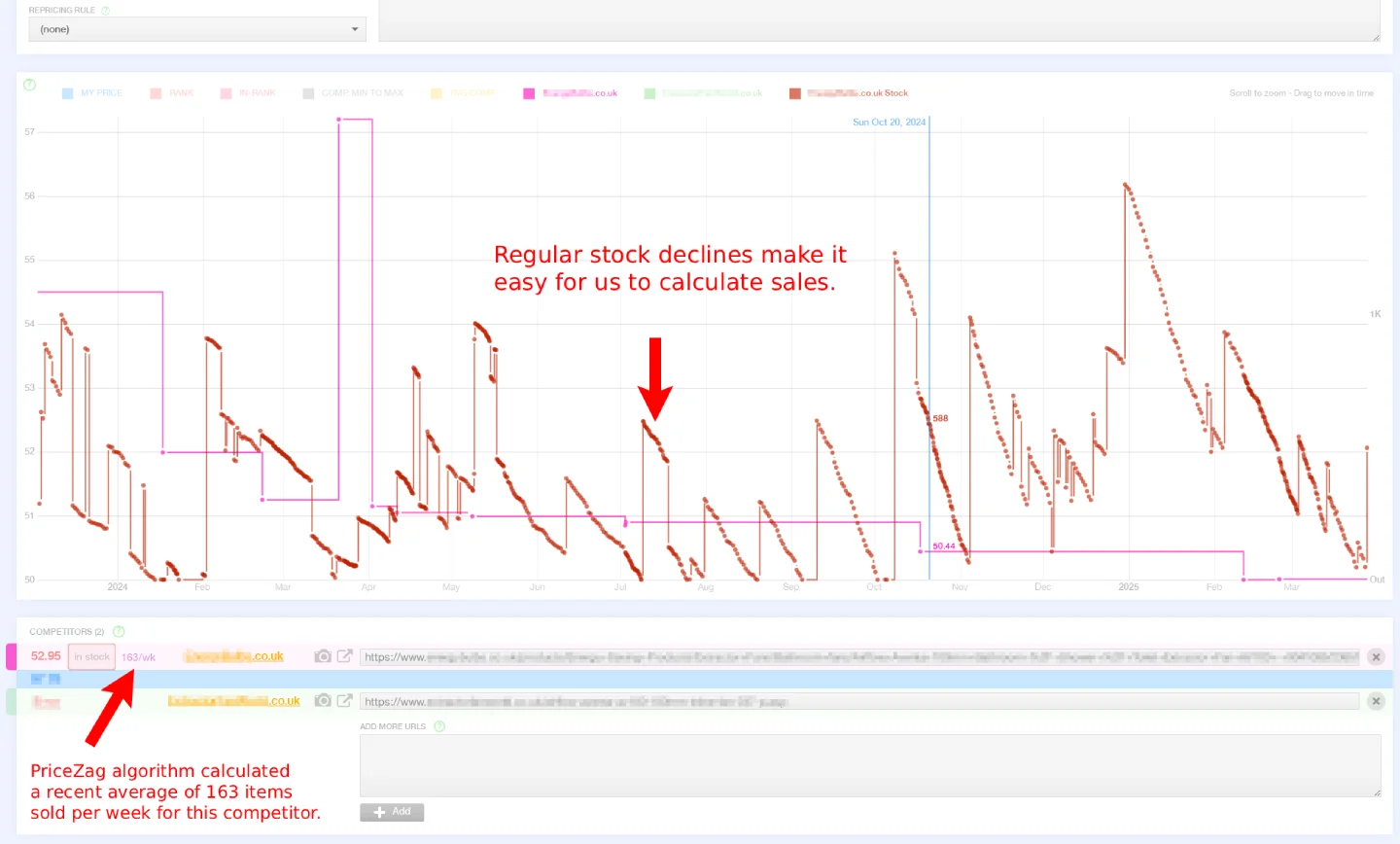
- For an individual product: Open the product in PriceZag. Under its graph, each competitor can have a sales estimate displayed in purple as N/wk - the approximate number of units sold per week. You can compare that figure with its price and stock history.
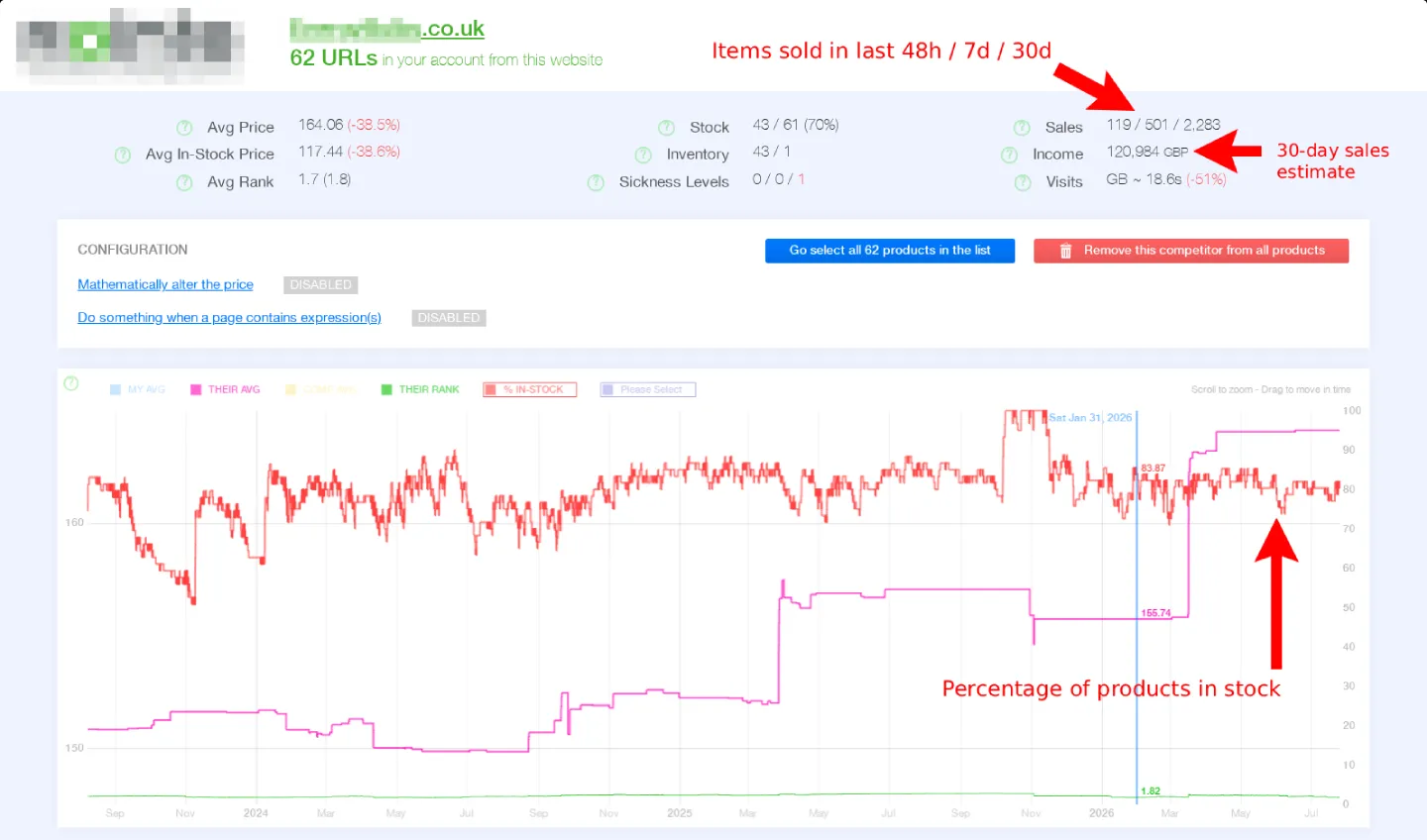
- For a competitor's website: Open Reports & Sheets > Domains and select the retailer, or search for its domain in your account. Its page shows estimated units sold across your monitored products over the last 48 hours, 7 days, and 30 days.
- For estimated income: The domain page also calculates an approximate 30-day revenue amount by combining estimated units sold with product prices, displayed in your selected currency. It is labeled Income in the dashboard.
- For comparisons: The dashboard's Best Sellers overview highlights competitors and products with the highest calculated sales, while Excel reports can include an Each Comp. Sales column for estimated weekly sales.
How accurate can competitor sales estimates be?
It depends heavily on the website. Some online stores display exact inventory quantities that change consistently as products sell and are replenished. Others display only In stock or Out of stock, conceal their quantities, or report stock numbers that fluctuate for unrelated reasons.
A useful way to judge the data is to look at the stock curves in PriceZag:
- Promising: Inventory falls in a reasonably steady, stair-step pattern, then jumps upward when new stock arrives. This sawtooth pattern often supports more believable sales estimates.
- Less reliable: Stock jumps up and down in apparently random ways, perhaps because the website changes its displayed quantities or draws from multiple stock locations.
- Not enough information: The website never exposes useful numerical quantities, or PriceZag has not yet collected enough history. In these cases a meaningful sales estimate may not be available.
Even a convincing stock curve is not proof of actual customer purchases. Returns, transfers, reservations, and inventory corrections can affect the numbers. Treat estimated competitor sales as a market signal to investigate, not as audited sales data.
What could you learn from these estimates?
When the stock data is consistent, estimated sales can give pricing and merchandising teams some interesting clues:
- Spot fast-moving products. Find products that appear to sell quickly at a competitor, including items you might be underestimating.
- Compare demand with price. See whether a competitor's apparent sales pace changes as its advertised price moves up or down.
- Watch other retailers' momentum. Compare estimated units sold across the monitored selection of competing stores.
- Find opportunities worth a closer look. Combine sales estimates with price alerts, availability and stock history to decide what deserves attention.
It's a powerful extra perspective to have alongside the price monitoring you're already doing - especially because you don't need access to a competitor's internal systems to uncover it.
Common questions
Can PriceZag really calculate my competitors' sales?
PriceZag can estimate product sales from visible inventory changes when enough numeric stock history is available. It does not see the retailer's actual orders, so the figures are estimates rather than verified sales.
Does the competitor need to display an exact number of items in stock?
Numerical inventory readings are the main source for these estimates. PriceZag can account for gaps and non-numeric observations within a useful history, but a website that only ever says "In stock" generally does not provide enough information to estimate unit sales.
Does the estimated income show a competitor's total business revenue?
No. It estimates 30-day revenue only for the products you're monitoring at that competitor, based on estimated units and observed product prices. It is not their full turnover, profit, or a record of completed transactions.
Is this a separate service I need to set up?
No separate sales-record integration is needed. Sales estimation is an additional insight derived from PriceZag's monitoring of competitor product pages, wherever usable stock history makes it possible.